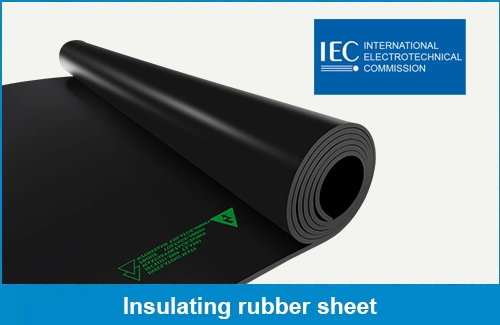
In modern power distribution facilities, high-voltage substations, and live-line working environments, electrical shock is a fatal risk that leaves no room for compromise. Selecting certified electrical switchboard matting is the ultimate baseline for ensuring personnel safety, protecting equipment, and achieving international project compliance.
However, importing or source-specifying generic "electrical rubber" without verifying strict international classifications is a critical safety and regulatory failure. To guarantee absolute dielectric protection, engineering buyers globally rely on the rigorous criteria established by the IEC 61111 standard.
Our production line delivers high-performance electrical switchboard matting in two premium structural surface configurations to meet diverse workplace engineering needs: Smooth Surface (Plain) Type for easy maintenance and cleanroom environments, and Anti-Slip Textured Type for enhanced mechanical traction and operator stability in high-traffic or oil-prone environments.
1. What are the Official Voltage Classes Defined by IEC 61111 2009?
The IEC 61111 2009 standard categorizes high-safety electrical switchboard matting into five distinct classes (Class 0, 1, 2, 3, and 4) based on their maximum operational voltage thresholds. Class 0 covers low-voltage applications up to 1KV AC, while the highest industrial designation, Class 4, is robustly engineered to withstand severe high-voltage operational stress up to 36KV AC. Each class corresponds to precise engineered thickness profiles optimized for both smooth and anti-slip matting styles.
Each safety class undergoes intensive dielectric proof tests and withstand tests in controlled laboratories. This rigorous process ensures zero punctures and zero leakage current during live-line operations under extreme mechanical stress.
2. IEC 61111 2009 Electrical Switchboard Matting Specification Matrix
When procurement engineers and site safety managers source electrical matting, they must cross-reference the actual workplace maximum voltage with the testing parameters specified under the IEC 61111 framework. Below is the certified engineering matrix for our Smooth and Anti-Slip variants required for international utility project bidding and compliance verification:
| Thickness (mm) | IEC 61111 Class | AC Working Voltage | Proof Test Voltage | Withstand Test Voltage | Available Surface Types |
|---|---|---|---|---|---|
| 3 | Class 0 | 1KV | 5KV | 10KV | Smooth & Anti-Slip |
| 4 | Class 0 | 1KV | 5KV | 10KV | Smooth & Anti-Slip |
| 5 | Class 0 | 1KV | 5KV | 10KV | Smooth & Anti-Slip |
| 6 | Class 0 | 1KV | 5KV | 10KV | Smooth & Anti-Slip |
| 3 | Class 1 | 7.5KV | 10KV | 20KV | Smooth & Anti-Slip |
| 4 | Class 1 | 7.5KV | 10KV | 20KV | Smooth & Anti-Slip |
| 5 | Class 1 | 7.5KV | 10KV | 20KV | Smooth & Anti-Slip |
| 6 | Class 1 | 7.5KV | 10KV | 20KV | Smooth & Anti-Slip |
| 7 | Class 2 | 17KV | 20KV | 30KV | Smooth & Anti-Slip |
| 8 | Class 2 | 17KV | 20KV | 30KV | Smooth & Anti-Slip |
| 9 | Class 3 | 26.5KV | 30KV | 40KV | Smooth |
| 10 | Class 3 | 26.5KV | 30KV | 40KV | Smooth |
| 11 | Class 3 | 26.5KV | 30KV | 40KV | Smooth |
| 12 | Class 4 | 36KV | 40KV | 50KV | Smooth |
| 13 | Class 4 | 36KV | 40KV | 50KV | Smooth |
| 14 | Class 4 | 36KV | 40KV | 50KV | Smooth |
3. Why Mechanical and Environmental Factors Matter Beyond Dielectric Strength
A frequent error in industrial B2B procurement is focusing exclusively on the electrical voltage rating while ignoring real-world physical duress. True IEC 61111 2009 compliant matting requires an advanced elastomeric compound—typically formulated from premium Natural Rubber or EPDM bases—to pass strict non-electrical stress testing:
- Mechanical Endurance (Tensile & Elongation): The rubber must maintain structural durability to prevent tearing, cracking, or punctures when heavy maintenance carts, machinery, or heavy-booted operators move across the electrical switchboard matting. Our ribbed/diamond anti-slip profiles add physical grip without compromising localized dielectric protection.
- Flame Retardancy (Category F): Safety is paramount. Under the official IEC 61111 flame-exposure test, if the matting catches fire via electric arcing, the compound must self-extinguish within 5 seconds once the ignition source is removed.
- Chemical and Oil Resistance (Category O & Category A): Vital for industrial environments and power generator rooms where exposure to aggressive transformer oils, industrial lubricants, or localized acid leaks is highly prevalent.
- Low-Temperature Flexibility (Category C): The matting rolls must remain perfectly pliable and crack-resistant even under heavy sub-zero environments as low as -35°C.
4. Sourcing Certified IEC 61111 Electrical Switchboard Matting?
Established in 2000 with over 15 years of industrial rubber export expertise, our enterprise supplies roll-by-roll certified dielectric safety matting in smooth and anti-slip designs to distributors and engineering projects in over 40 countries. We provide full Technical Data Sheets (TDS), customized thickness adjustments, and rigorous international testing support.